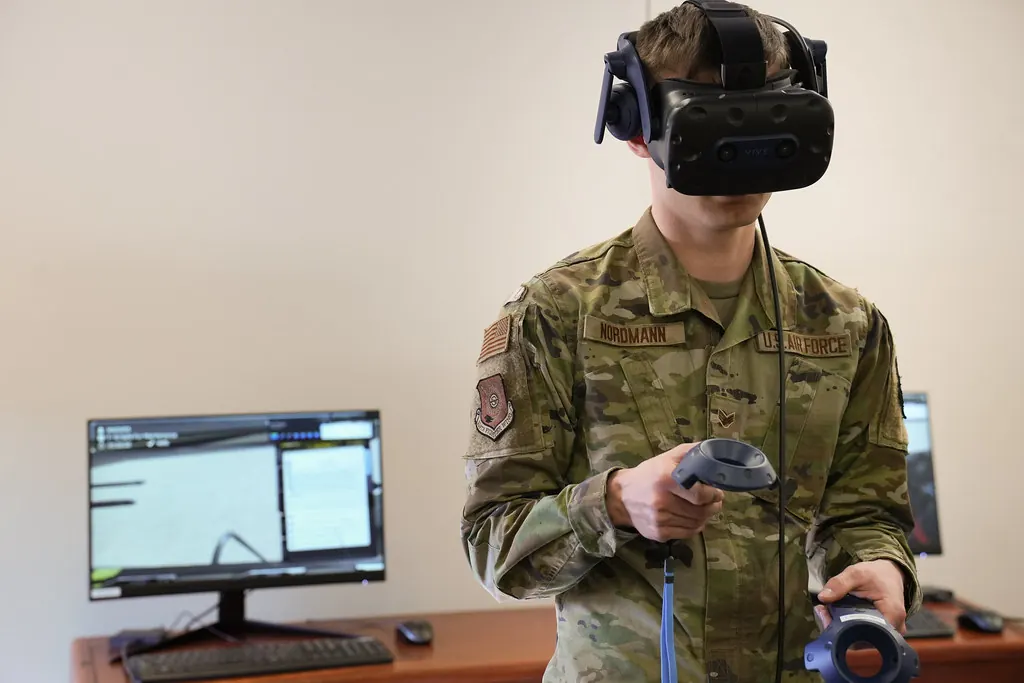
Ask most executives what virtual reality is for, and the answer is usually "gaming," or at best, "the headset we tried once at a trade show." That reputation is years out of date. The same head-mounted displays that render open-world adventures are now standard equipment on shop floors, in surgical training wards, on architecture review calls and inside enterprise onboarding programs — anywhere a business needs people to rehearse a high-stakes task, evaluate a design before it's built, or be somewhere they physically can't.
The shift is being driven by three things at once: headsets have gotten lighter and cheaper, WebXR now lets experiences run straight from a browser with no app install, and a simple economic argument has held up under scrutiny — a mistake made in a headset is free, while the same mistake made on a factory floor, an operating table or a half-built high-rise is not. Here is where VR is actually earning its budget in business today, category by category.
1. Training simulation without the real-world risk
This is where enterprise VR spend is heaviest, and for good reason. Aviation maintenance crews, power-plant operators, defense and emergency-response teams, and heavy-machinery operators all face the same constraint: the training scenario that teaches the most (an engine fire, a chemical spill, a live-fire decision under pressure) is exactly the one you can't safely stage in real life more than once. VR turns that constraint into a repeatable exercise. A trainee can run the same failure scenario fifty times before lunch, and the system logs exactly where their attention went, how long they hesitated, and whether they followed protocol — data a clipboard-and-instructor model never captured.
The return shows up in two places: fewer real-world incidents during the learning curve, and a shorter path from hire to fully competent, since simulation hours don't compete with production downtime the way live equipment time does.
2. Product design and engineering review, before a single part is cut
Physical prototyping is slow and expensive precisely because every design change means waiting for a new part to be milled, printed or assembled. Reviewing a CAD model on a flat monitor solves part of that, but a monitor still can't tell a design team whether two components will actually clash in three-dimensional space, or whether a control panel is reachable at true human scale. Walking the same model at 1:1 in VR does. Design reviews that used to require a physical mockup and a room full of stakeholders now happen with distributed engineers dropping into the same virtual model, flagging clearance issues and ergonomics problems while the design is still just geometry — not yet a bill of materials.
The compounding effect is fewer late-stage change orders, which is where manufacturing budgets actually get destroyed.
3. Retail, real estate and the virtual showroom
Not every product or property can be everywhere a buyer is. Virtual showrooms let a retailer put a full catalog in front of a shopper who will never visit a physical store, and let a real estate developer walk an overseas buyer through a unit that hasn't finished construction yet. For high-consideration purchases especially, the ability to spend ten unhurried minutes inside a space — turning around, checking sightlines, testing scale — closes deals that a photo gallery and a floor plan PDF cannot. It also compresses the sales cycle: fewer site visits are needed before a buyer is ready to commit, which matters as much to the seller's cost of sale as it does to the buyer's convenience.
4. Healthcare: rehearsal, rehabilitation and pain management
Clinical VR has moved well past novelty. Surgeons rehearse complex or rare procedures on a patient-specific 3D model before ever picking up an instrument on the actual patient. Medical students practice anatomy and emergency response without waiting for a rotation slot to open up. On the recovery side, VR-guided physical rehabilitation keeps patients engaged in repetitive exercises they'd otherwise abandon, and distraction-based VR is now a documented tool for reducing perceived pain during burn treatment and other painful procedures — no pharmacology required.
5. Remote collaboration for distributed teams
Video calls flatten a room into a grid of faces and lose everything spatial: who's looking at what, who's about to speak, where the whiteboard is. Spatial VR meetings restore that context for the specific cases where it matters — design reviews, training walkthroughs, and onboarding a new hire who needs to "stand next to" a colleague and a piece of equipment that are, in reality, a continent apart. It's not a replacement for every meeting; it's the right tool for the meetings where being face-to-face used to be non-negotiable, and now doesn't require a plane ticket.
6. Where VR compounds with AI and blockchain
The highest-leverage VR deployments we build rarely stay standalone for long. Pair a VR training environment with AI, and the simulation stops being static — it can adapt scenario difficulty in real time based on trainee performance, or flag which specific decisions led to a failed outcome. Pair a virtual showroom or a digital twin with blockchain, and ownership of virtual goods, verified provenance of a showcased asset, or access rights to a premium VR experience become tamper-proof and transferable, not just a database row on a vendor's server. Businesses that treat VR as one layer in a broader AI-and-blockchain stack, rather than a one-off pilot, are the ones seeing it stick past the first budget cycle.
Frequently asked questions
How is Virtual Reality used in healthcare?
VR is used for medical education, surgical simulation, rehabilitation, pain management, therapy, and visualisation of medical data. It allows healthcare professionals and students to practice procedures in controlled virtual environments without putting patients at risk.
How is VR transforming the retail industry?
Retailers use VR to create immersive shopping experiences, virtual fitting rooms, product demonstrations, and interactive stores. Customers can explore products virtually and, in some cases, customise or visualise them before purchasing.
How is VR used in real estate?
Real estate companies use VR for virtual property tours, 3D walkthroughs, architectural visualisation, and showcasing properties that are still under construction. Buyers can explore a property remotely, reducing the need for repeated physical visits.
What is a virtual showroom, and how can businesses use it?
A virtual showroom is an interactive digital environment where customers can explore products or spaces remotely. Businesses can use it to showcase furniture, automobiles, homes, appliances, luxury products, and other offerings, giving customers a more immersive alternative to traditional catalogues or websites.
What are the benefits of using VR for business beyond gaming?
VR can help businesses improve customer engagement, product visualisation, employee training, remote collaboration, sales presentations, and customer decision-making. It can also let companies showcase products or properties to customers who can't visit a physical location.
Starting a pilot without over-investing
The businesses that get the most out of VR don't start with an enterprise-wide rollout. They pick one measurable, high-cost problem — a training bottleneck, a prototyping cycle, a sales process with too many site visits — and build a focused pilot around it with a clear before-and-after metric. That's enough to prove the economics before committing budget to headsets for an entire workforce.
If you're weighing where VR would actually move a number in your business, talk to our team — we'll help you find the use case worth piloting first.