
Why Your Business Needs a Multi-Agent AI Orchestrator? Top 4 Business Use Cases
BSI – 20th May, 2026
For the past few years, enterprises have treated Large Language Models (LLMs) like that lone intern—forcing a single prompt or a rigid, linear chain to solve highly complex, multi-layered business problems.
The results? Hallucinations, fragile workflows, and broken automation.
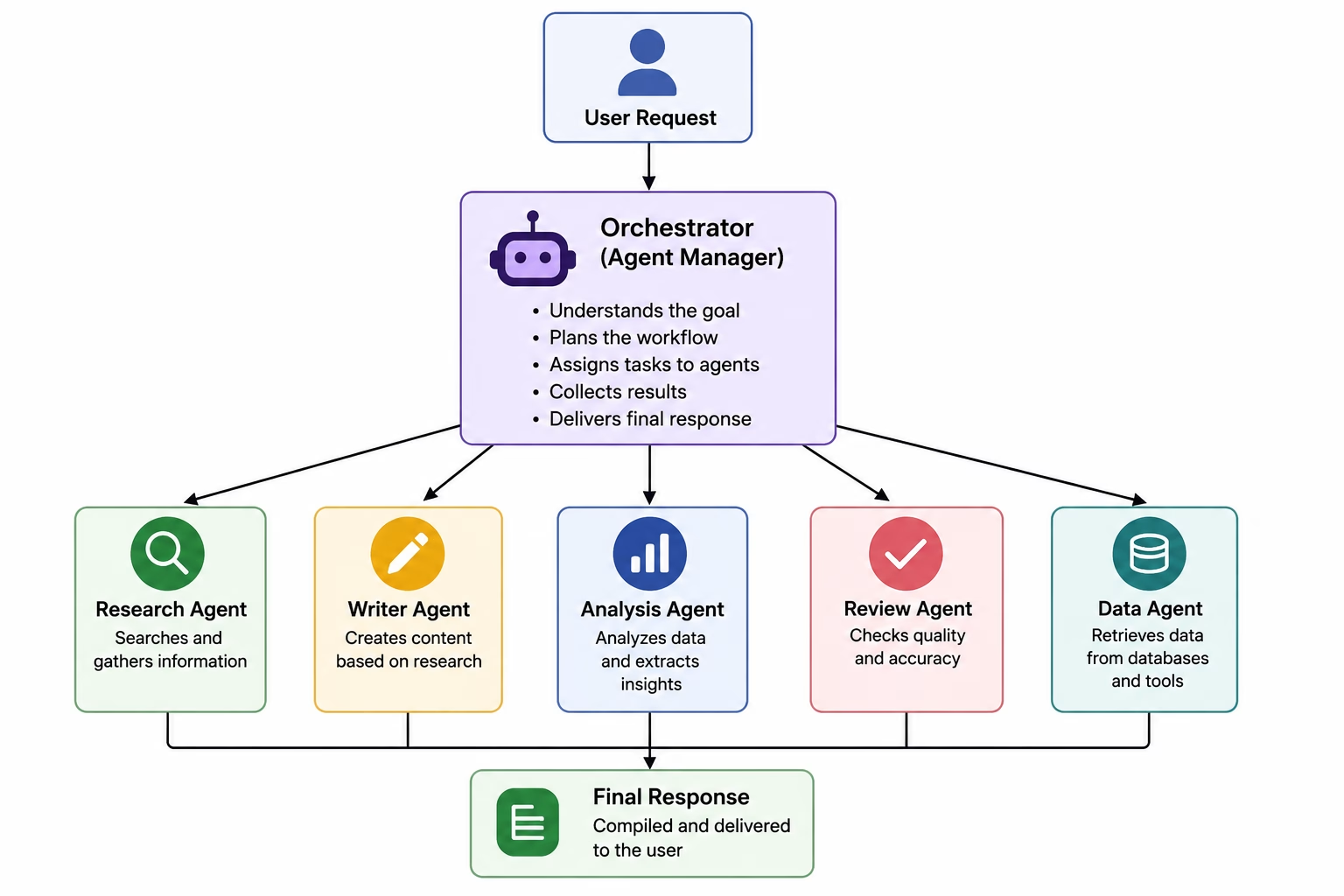
Hence, we have started working on the Multi-Agent AI Workflow Orchestrator. A Multi-Agent AI Workflow Orchestrator becomes important when businesses want AI systems to do more than answer questions — they want AI to execute real operational work reliably, at scale, and across departments. Instead of relying on a single AI to do everything, the future of enterprise automation belongs to autonomous teams of specialized AI agents. But a team of specialists is just a chaotic crowd without a manager.
The orchestrator acts as the ultimate digital project manager—delegating tasks, managing shared memory, and synthesizing outputs to solve complex enterprise challenges at scale. Here is how it works, and why it is rapidly becoming the backbone. A Multi-Agent AI Workflow Orchestrator is a system that coordinates multiple AI agents so they can work together on a larger task instead of relying on one single model or prompt. Such as;
- Sales Operations
- Compliance Checks
- Document Processing
- Analytics/Reporting
- Procurement
- HR Onboarding
- Customer Support
Here is a clarification and breakdown of how Multi-agents work:
-
Multi-Agent AI Supply Chain & Logistics Orchestrators
Instead of simple automation scripts, businesses are deploying networks of specialized AI agents that manage the entire lifecycle of a shipment.
- The Workflow: Agent A monitors global weather and port congestion data.
- Agent B automatically reroutes a delayed cargo shipment and negotiates spot rates with alternative carriers.
- Agent C drafts the updated customs paperwork.
- Human-in-the-Loop (HITL): If a rerouting decision exceeds a certain financial threshold, the system pauses and pings a logistics manager’s smartphone for one-click approval.
-
Next-Gen Venture Capital & Private Equity Platforms
The text explicitly highlights a massive pain point in private markets: data fragmentation and manual reporting.
- The Workflow:
- Data-Driven Pipelines: AI agents automatically ingest messy PDF financial statements from portfolio companies, normalize the data, and update the fund’s master cap table.
- Blockchain Value Settlement: Distributions to Limited Partners (LPs) are executed via smart contracts. When an exit event occurs, the blockchain securely, instantaneously, and transparently distributes capital to LPs based on coded waterfall logic.
- Automated Reporting: The platform generates and sends customized quarterly performance reports to LPs without a human analyst spending weeks in Excel.
-
Asset Tokenization Pipelines (FinTech / Real Estate)
Bringing real-world assets (RWA) like real estate, art, or private debt onto the blockchain to fractionalize ownership and increase liquidity.
- The Workflow:
- Flexible Software Architecture: Connects traditional banking rails (for fiat investment) to a blockchain network.
- AI Compliance Agent: Continuously scans changing local securities laws to ensure the tokenized asset remains compliant.
- Blockchain Settlement: Issues digital tokens representing fractional ownership to investors, manages secondary market trading, and automates dividend payouts securely.
-
Smart Construction Project Management
Supply delays, compliance issues, and change orders notoriously plague construction.
- The Workflow:
- Domain-Specific AI: Pre-trained on local building codes, blueprints, and standard supplier contracts.
- Automated Procurement: AI monitors inventory on-site via IoT sensors. When rebar or concrete runs low, it automatically orders more from pre-approved vendors.
- HITL Safety/Budget Check: If a change order is triggered due to an unexpected site condition, the AI recalculates the budget and timeline impact, presenting a clear “Approve/Deny” dashboard to the Project Superintendent
A Multi-Agent Workflow Orchestrator becomes important when businesses want AI systems to do more than answer questions — they want AI to execute real operational work reliably, at scale, and across departments.
Instead of one AI trying to handle everything, businesses can build teams of specialized AI agents coordinated by an orchestrator.